
The American Cochlear Implant Alliance (ACI Alliance) CI2026 Chicago Conference, held May 6–9, 2026 at the Hyatt Regency Chicago, brought together leading surgeons, audiologists, researchers, and allied healthcare professionals from across the country and around the world. The annual conference is the premier scientific meeting in the field of implantable hearing devices, providing a venue to share advancements, address critical issues, and present groundbreaking research in the realm of hearing restoration.
Dr. Mary Rose Goldstein, lead audiologist at the Center for Neurosciences (CNS), was an active participant throughout the conference, contributing in three distinct ways: as a podium presenter of original research from the CNS Ear & Hearing team, as a featured contributor to the Cochlear Americas industry breakfast symposium, and as a participant on the conference’s ethics panel. Her presence across these very different formats — original science, industry-partnered education, and professional ethics — reflects her growing national role in shaping how the audiology community delivers, validates, and responsibly frames cochlear implant care.
Podium Presentation: Remote, Reduced-Visit Care in the Elderly
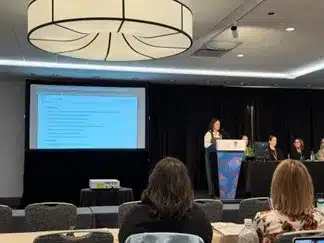
In Concurrent Session 8-2 (Remote Care in CI Practices) on Saturday morning, Dr. Goldstein delivered a podium presentation titled “Optimizing Post-Activation Audiology Care: Maintaining Outcomes Through Remote, Reduced-Visit Protocols in an Elderly Population.” The work was a collaborative project of the Ear & Hearing team at CNS, with co-authors Dr. Alissa Knickerbocker, Dr. Margaret Fries, Dr. Abraham Jacob, and Owen Woodruff, B.A.
The presentation addressed one of the most pressing operational challenges facing cochlear implant programs nationally — how to deliver high-quality, lifelong post-activation care in the face of expanding candidacy criteria, a national shortage of cochlear implant audiologists, and limited clinic capacity. Older adults are now the fastest-growing cohort of cochlear implant recipients in the United States, yet they have historically been underrepresented in remote care studies due to concerns about technology adoption and adherence to reduced-visit schedules.
To address this gap, the CNS Ear & Hearing team developed and implemented a streamlined post-activation protocol that replaces several in-person follow-ups with brief remote check-ins led by an audiology technician. The new pathway preserves the same number of patient contact points while reducing in-person clinic time by two hours per patient. Dr. Goldstein presented a retrospective comparison of patients managed under the traditional 2024 protocol versus the streamlined 2025 protocol in a primarily elderly cohort with a mean age of 74.3 years — including patients as old as 91 — and demonstrated that 73% of elderly patients successfully completed their remote assessments. Six-month CNC word recognition scores were essentially identical between the two cohorts (mean 54% in each group, p = 0.49), and patient-reported global satisfaction was preserved, with the streamlined-protocol group reporting modestly higher overall satisfaction. At the program level, the new protocol was associated with a 38% increase in cochlear implant evaluations, a 21% increase in cochlear implant surgeries, and a 6–8 week reduction in patient wait times.
These findings demonstrate that a thoughtfully designed remote, reduced-visit care model can maintain clinical outcomes in elderly cochlear implant recipients while meaningfully expanding access to timely care — an important contribution as cochlear implant programs across the country grapple with rising demand and constrained resources.
Cochlear Americas Breakfast Symposium
Earlier that same Saturday morning, Dr. Goldstein contributed to the Cochlear Americas–sponsored industry breakfast symposium, “Optimizing Outcomes for Every Patient Through Evidence-Based Hearing Care,” held in the Grand Ballroom of the Hyatt Regency Chicago. Industry symposia at CI2026 bring together leading clinicians from high-volume programs to share evidence-based approaches that translate research into day-to-day cochlear implant practice. Dr. Goldstein’s involvement in this educational program reflects the recognition the CNS Ear & Hearing team has earned within the cochlear implant community as a source of practical, outcomes-driven clinical protocols.
Ethics Panel
Dr. Goldstein also took part in the conference’s ethics panel, joining colleagues from across the country in a discussion of the ethical considerations facing cochlear implant clinicians today. As candidacy criteria expand, technology evolves, and care models shift toward remote and reduced-visit delivery, the field is increasingly called upon to ensure that innovation continues to serve patients’ best interests. Her participation underscores a long-standing commitment within the CNS Ear & Hearing department to thoughtful, patient-centered care — and to engaging directly in the professional conversations that shape standards of practice.
A National Voice for the CNS Ear & Hearing Department
The breadth of Dr. Goldstein’s engagement at CI2026 Chicago — original podium research, industry-sponsored education, and professional ethics — reflects the national and international caliber of the work being conducted within the Ear & Hearing department at the Center for Neurosciences. Dr. Goldstein, Dr. Knickerbocker, Dr. Fries, and Dr. Jacob continue to drive innovation at the bedside and at the podium, generating practical, evidence-based protocols that improve the lives of patients with hearing loss in Southern Arizona and far beyond. Ear & Hearing | Center for Neurosciences remains committed to its mission of providing personalized, compassionate, and state-of-the-art care that generates outstanding clinical outcomes and high patient satisfaction.