
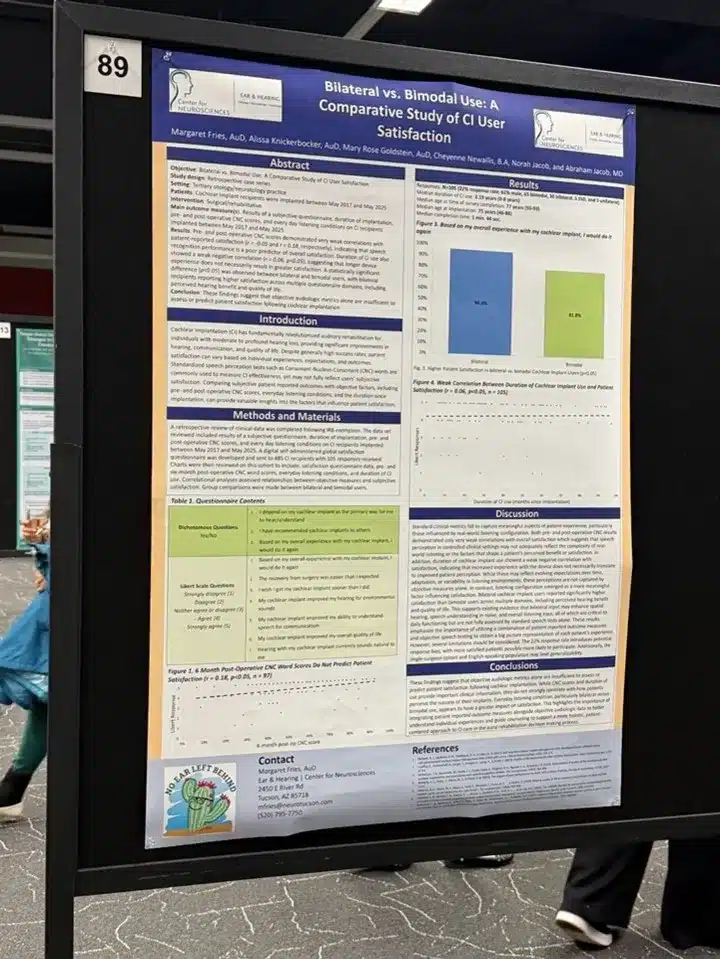
Research from the Ear & Hearing program at Center for Neurosciences shows that standardized speech-perception scores do not reliably predict how satisfied patients are with their cochlear implants — and that real-world listening configuration matters most.
CHICAGO, May 9, 2026 —
Researchers from Ear & Hearing | Center for Neurosciences (CNS Tucson) presented new findings at CI 2026, the 13th annual Conference on Cochlear Implants of the American Cochlear Implant Alliance, held May 6–9, 2026 at the Hyatt Regency Chicago. In Poster #89, “Bilateral vs. Bimodal Use: A Comparative Study of CI User Satisfaction,” the team reported that bilateral cochlear implant (CI) users were significantly more satisfied with their devices than bimodal users (a CI in one ear plus a hearing aid in the other), and that traditional speech-perception testing was a poor predictor of patient-reported outcomes.
Why this study matters
Cochlear implantation has fundamentally changed auditory rehabilitation for adults and children with moderate to profound hearing loss. While Consonant-Nucleus-Consonant (CNC) word scores have long served as the standard measure of CI effectiveness, clinicians have increasingly questioned whether scores obtained in a controlled sound booth truly reflect a patient’s day-to-day listening experience. The Center for Neurosciences team designed this retrospective case series to answer a deceptively simple question: do the metrics we routinely measure actually predict whether our patients are happy with their implants?
Study design
The investigators retrospectively reviewed clinical data on adult cochlear implant recipients implanted at Center for Neurosciences between May 2017 and May 2025. A digital, self-administered global satisfaction questionnaire was sent to 485 CI recipients, yielding 105 responses (22% response rate; 61% male). The cohort included 65 bimodal users, 30 bilateral users, 5 single-sided deafness (SSD) users, and 5 unilateral users. Median age at implantation was 75 years (range 46–88), median age at survey completion was 77 years (range 55–93), and median duration of CI use was 3.19 years. Charts were reviewed for satisfaction questionnaire data, pre- and six-month post-operative CNC word scores, everyday listening conditions, and duration of CI use. Correlational analyses examined relationships between objective measures and subjective satisfaction, and group comparisons were made between bilateral and bimodal users.
Key findings
Pre- and post-operative CNC scores demonstrated very weak correlations with patient-reported satisfaction (r = −0.05 and r = 0.18, respectively), indicating that booth-based speech recognition performance is a poor predictor of overall satisfaction. Duration of CI use also showed a weak negative correlation with satisfaction (r = 0.06, p < 0.05), suggesting that more years with the device does not necessarily translate to greater satisfaction.
By contrast, listening configuration emerged as a meaningful driver of patient experience. A statistically significant difference (p < 0.05) was observed between bilateral and bimodal users, with bilateral recipients reporting higher satisfaction across multiple questionnaire domains, including perceived hearing benefit and quality of life. When asked, “Based on my overall experience with my cochlear implant, I would do it again,” 96.4% of bilateral users responded affirmatively, compared with 81.8% of bimodal users.
Clinical significance
These findings carry direct relevance for the cochlear implant program at Center for Neurosciences, which serves a broad referral base across southern Arizona. The data support a more proactive approach to candidacy counseling and post-implantation rehabilitation: patients considering a contralateral implant should be informed that bilateral input is associated with measurable gains in real-world listening ease, spatial hearing, and quality of life that conventional speech testing alone is unlikely to capture. The findings also reinforce the importance of routinely incorporating patient-reported outcome measures (PROMs) into clinical decision-making — particularly when counseling bimodal users on whether and when to pursue sequential implantation.
Lastly, the study underscores a broader point for the field: objective audiologic metrics alone are insufficient to assess or predict patient satisfaction following cochlear implantation. A combination of PROMs and objective speech testing offers a more complete picture of each patient’s experience and supports a more holistic, patient-centered approach to aural rehabilitation.
Limitations
The authors acknowledge several limitations. The 22% response rate introduces potential response bias, with more satisfied patients possibly more likely to participate. The study is also drawn from a single-surgeon cohort and an English-speaking population, which may limit generalizability.
Study authors
Margaret Fries, AuD; Alissa Knickerbocker, AuD; Mary Rose Goldstein, AuD; Cheyenne Newallis, B.A.; Norah E. Jacob; and Abraham Jacob, MD. All authors are affiliated with Ear & Hearing | Center for Neurosciences in Tucson, Arizona.
About CI 2026
CI 2026, the 13th annual Conference on Cochlear Implants organized by the American Cochlear Implant Alliance, was held May 6–9, 2026 at the Hyatt Regency Chicago. The multidisciplinary meeting brought together otologists, neurotologists, audiologists, speech-language pathologists, and researchers from across North America and beyond. This year’s program highlighted optimizing clinical efficiency and program growth, mental health comorbidities in CI patients, cognition and aging, care for non-English-speaking populations, and applications of machine learning and artificial intelligence in cochlear implant care.
About Ear & Hearing | Center for Neurosciences. Ear & Hearing is the otology, neurotology, and audiology department at Center for Neurosciences in Tucson, Arizona. The program offers comprehensive evaluation and management of hearing and balance disorders, including a cochlear implant program, skull base surgery, vestibular schwannoma management, stapes surgery, chronic ear surgery, pediatric hearing loss evaluation, ototoxicity monitoring, and amplification with hearing aids. Ear & Hearing serves a broad catchment area across Arizona, New Mexico, Southern Texas, Southern Nevada, parts of Colorado, and even California.