
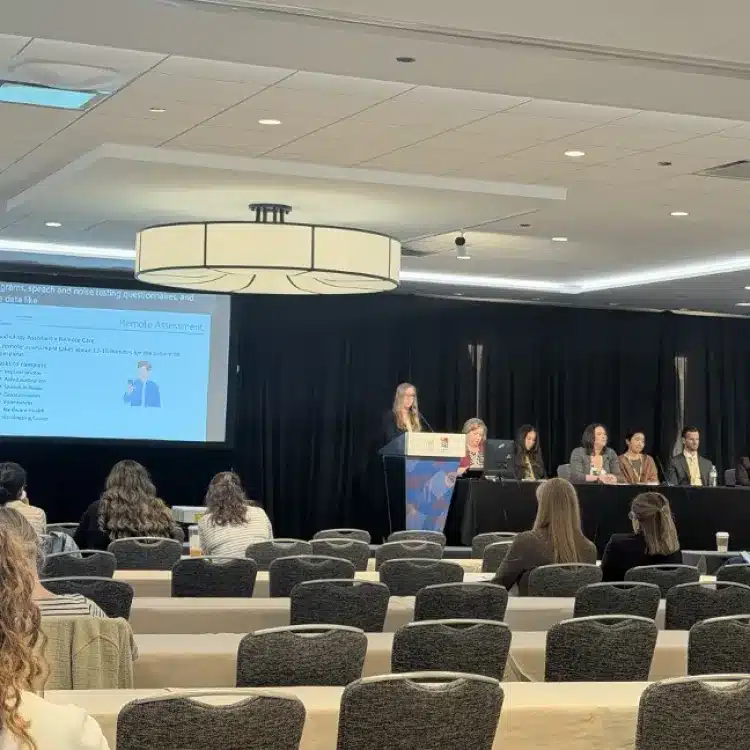
The American Cochlear Implant Alliance (ACI Alliance) CI2026 Conference brought together leading surgeons, audiologists, scientists, and allied healthcare professionals at the Hyatt Regency Chicago from May 6–9, 2026. The annual meeting is the premier scientific gathering in the field of cochlear implantation, dedicated to disseminating multi-disciplinary research that informs clinical practice and expands access to hearing restoration for patients across the United States and around the world.
Dr. Alissa Knickerbocker, Doctor of Audiology at the Center for Neurosciences (CNS) Ear & Hearing Department, took the podium at CI2026 to present “Utilizing Audiology Assistants to Streamline Remote Cochlear Implant Follow-Up Care.” The work was a true team effort, co-authored with Dr. Mary Rose Goldstein, Dr. Margaret Fries, Dr. Abraham Jacob, and Owen Woodruff, B.A., our audiology assistant who was critical to the project. It reflects the growing national conversation around how high-volume cochlear implant programs can keep pace with rapidly expanding candidacy criteria without compromising quality of care.
Dr. Knickerbocker’s presentation addressed one of the most pressing operational challenges facing cochlear implant centers nationwide. As Medicare and FDA criteria have broadened in recent years, demand for cochlear implant care has outstripped clinical capacity, with many programs now scheduling new candidate evaluations at least eight to ten weeks out. Her team’s solution, implemented at CNS in January 2025, integrates a specially trained audiology assistant with remote post-activation assessments to replace two routine in-person follow-up visits in the standard care pathway. The 12–15 minute remote evaluations capture implant photos, aided audiograms, speech-in-noise testing, validated questionnaires, electrode impedances, device hardware health, and datalogging — the same objective data audiologists rely on to confirm that a stable cochlear implant map continues to perform well — without requiring the patient to drive into clinic or occupy one of the department’s sound booths.
The early outcomes data were compelling. Over the first program year, the streamlined pathway returned 24 clinic hours to the audiology team for newly implanted patients and an additional 14 clinic hours for established cochlear implant recipients — time that has been redirected toward new candidate evaluations and complex troubleshooting of existing patients. Twenty-two of twenty-four newly implanted patients also completed structured educational sessions with their device manufacturer, reinforcing patient confidence and independent device management. Patients themselves reported reduced travel burden, greater scheduling flexibility, improved confidence with their devices, and shortened wait times — gains particularly meaningful for the many patients traveling long distances to Tucson for specialty cochlear implant care.
Dr. Knickerbocker’s podium presentation at ACI Alliance CI2026 underscores the ongoing role of Ear & Hearing | Center for Neurosciences as a nationally engaged cochlear implant program contributing original clinical research that shapes how cochlear implant care is delivered across the country. Her work — alongside the broader Ear & Hearing team’s continued presence at the leading otology, audiology, and cochlear implant meetings — affirms the department’s commitment to advancing the science and practice of hearing restoration for the Southern Arizona community and beyond.